
The Reality Show
When tragedy becomes something people observe instead of confront.

A quiet afternoon rested over the classroom.
Sunlight came through the tall windows. Dust moved slowly inside the light like tiny drifting thoughts.
The lesson had ended a few minutes ago.
Chairs scraped the floor. Bags zipped. Students laughed as they walked into the hallway.
Soon the room became quiet.
Only a few students remained.
The teacher noticed but did not interrupt.
One student stood near the desk for a moment, unsure whether to speak.
Then the student finally did.
Student:
Sir… can I ask you something?
Teacher:
Of course.
The student hesitated.
For a moment the room felt uncertain.
Then the student spoke.
Student:
Why is the world
always at war?
A few students near the door slowed down.
One of them leaned against a desk.
Another stayed where they were, listening.
The teacher did not answer immediately.
Outside, voices from the hallway faded.
The teacher slowly sat down. The chair gave a small squeak.
Teacher:
That’s a dangerous question.
Student:
Adults must know the answer.
You run countries.
You write laws.
You teach us history.
The teacher smiled softly.
Teacher:
You think we understand the world better than you do.
Student:
Don’t you?
The teacher looked out of the window for a moment.
Teacher:
Sometimes I think children see things more clearly.
A student near the back spoke.
Student 2:
My uncle says wars happen because powerful people want more power.
Teacher:
Sometimes that is true.
Another student turned around from their chair.
Student 3:
My dad says the world has always been like this.
He says humans never change.
The first student frowned.
Student:
But wars keep happening.
Every year there is another one.
Different place, same suffering.
The teacher nodded.
Teacher:
Yes.
Student:
If everyone says they want peace,
why does the fighting never stop?
Another student pulled a chair and sat down.
Student 4:
My mother stopped watching the news.
She says it makes her feel helpless.
Teacher:
Many people feel that way.
Student 4:
She says watching suffering every day is too heavy.
The teacher rested both hands on the desk.
He paused before speaking.
Teacher:
People often think wars exist because of leaders.
Or armies.
Or governments.
The classroom went still.
Teacher:
But wars survive because the rest of us learn how to live beside them.
Not on purpose.
Just slowly.
Student:
Used to them?
Most people don’t want war.
Teacher:
That is true.
Another pause.
Student 2:
But we are far away from those places.
What can normal people even do?
The teacher leaned back in the chair.
Teacher:
First something else happens.
We start watching it.
Student 3:
Watching?
Teacher:
Yes.
Suffering now travels through screens.
Bombs falling.
Cities burning.
Families running with nothing.
Children crying.
Schools in rubble.
Hospitals destroyed.
Refugees walking until there is nowhere left to walk.
The students listened quietly.
Student:
It’s always on the news.
Those shaky phone videos.
Teacher:
And what do most of us do after watching?
We feel something.
Sadness. Anger.
But nothing in our room changes.
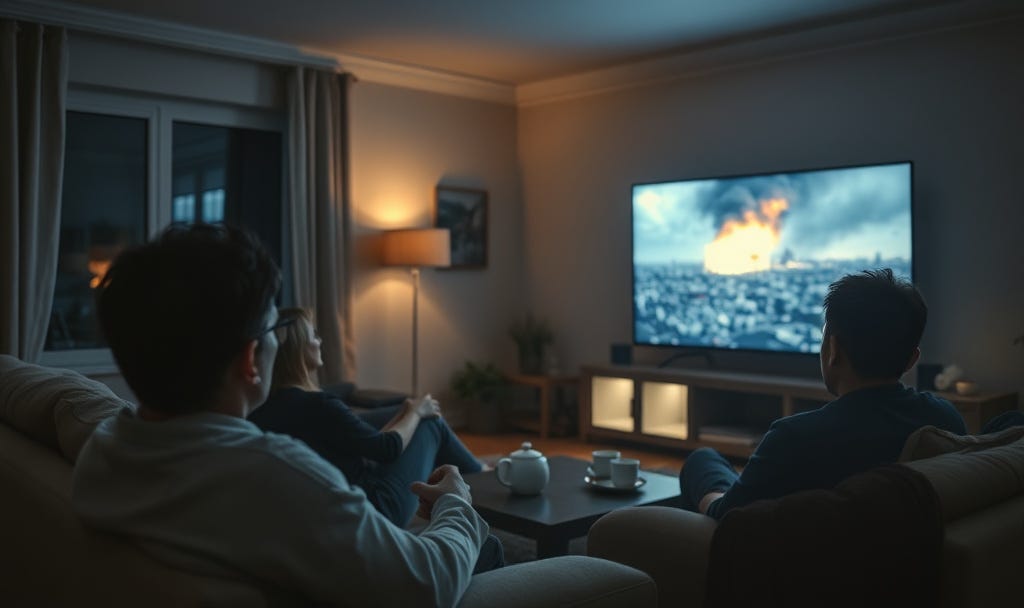
Our tea is warm.
Our house is quiet.
Our family is safe.
Student 4:
So life just continues.
Teacher:
Yes.
We can watch horror
and still ask what’s for dinner.
Once the mind learns that
scrolling becomes easier.
Student:
We keep scrolling.
Teacher:
Yes.
Then we put the kettle on.
A quiet laugh came from one student.
But it faded quickly.
Student 3:
My brother says people argue online about wars all the time.
Teacher:
That happens a lot.
Student 3:
They pick sides like football teams.
Teacher:
Sometimes people talk about the dead as if they’re discussing a match result.
Student 2:
My uncle says the news channels repeat the same footage again and again.
Teacher:
They do.
Student 2:
Why?
Teacher:
Attention.
Attention brings viewers.
Viewers bring advertisements.
Advertisements bring money.
The room stayed quiet.
Student 4:
So suffering becomes… content?
Teacher:
Sometimes.
Not always with bad intentions.
But the result can feel the same.
Student:
That sounds cruel.
Teacher:
Sometimes it’s just the system people end up living inside.
But something else also happens.
The teacher looked at the light resting across the desks.
Teacher:
War can start feeling unreal.
For the people fighting
distance can make violence feel mechanical.
Like pressing buttons.
For the people watching safely at home
it becomes something on a screen.
Something far away.
Student 3:
Like a video.
Teacher:
Yes.
And both sides risk forgetting something important.
Student:
What?
Teacher:
The dead were real people.
A quiet moment passed.
Student 4:
People also make documentaries.
Podcasts.
Videos explaining wars.
Teacher:
Some of those help people understand the world.
But sometimes tragedy becomes opportunity.
Student 2:
So being informed is not enough?
Teacher:
It can be a beginning.
But watching is not the same as acting.
Sharing is not the same as protecting people.
Sometimes staying informed is just a respectable way of doing nothing.
Student:
So what do people do instead?
Teacher:
We protect our comfort first.
If bombs fall far away
life continues normally.
Go to work.
Watch our favourite shows.
Complain about traffic.
Complain about the weather.
Complain about small things.
Meanwhile somewhere else
cities collapse.
The students were quiet now.
Student:
That feels wrong.
Teacher:
Yes.
That may be the worst thing about us.
We can get used to almost anything.
Student 3:
What is the dangerous part?
Teacher:
When violence stops shocking people.
When war becomes normal news.
When images of destruction no longer disturb sleep.
When the mind accepts suffering
as part of everyday life.
Student:
I think that is already happening.
The teacher did not argue.
Teacher:
Maybe.
The first student spoke again.
Student:
If people stay silent
does that make them part of the problem?
The teacher took a slow breath.
Teacher:
Silence does not pull the trigger.
But silence builds the room
where the trigger can be pulled again.
The classroom became very still.
Student 2:
So everyone shares responsibility?
Teacher:
In different ways.
The teacher looked around at the empty desks.
Teacher:
Humanity often waits for heroes.
A brave leader.
A great movement.
A historic moment.
But change usually begins much smaller.
With someone asking a question.
With someone refusing to look away.
With someone speaking
when silence feels easier.
The first student looked down at the desk.
Student:
Like asking this question?
The teacher smiled.
Teacher:
Yes.
Exactly like that.
The bell rang suddenly in the hallway.
Students began moving through the corridors again.
Voices returned to the building.
The students slowly stood up.
Bags lifted onto shoulders.
Student 3:
I never thought about silence this way before.
Teacher:
Most people do not.
One of the students paused near the door.
Student 4:
Do you think people will ever stop watching
and start doing something?
The teacher looked at the empty chairs.
Teacher:
I hope so.
Student:
What makes you believe that?
The teacher looked back at them.
Teacher:
Because someone always asks the question.
The students nodded.
Then they walked into the hallway.
The classroom returned to quiet again.
Sunlight still rested on the desks.
Dust still moved slowly in the air.
The teacher sat alone for a while.
Listening to the distant noise of the school.
Outside the building the world continued its ordinary rhythm.
Cars moved.
People hurried.
Screens glowed inside homes and shops.
News alerts appeared.
Another conflict.
Another city in danger.
People watched.
Some felt sadness.
Some felt anger.
Many kept scrolling.
And somewhere
in another quiet room
someone asked a question
most adults are afraid to answer.


I love it.
I think you stepped into my classroom. Not discussed this well, but it's discussed.
This story is scary with a lingering truth...how easy it is for us to scroll past tragedy, watch suffering from a distance, and convince ourselves it’s someone else’s problem. It reminds us that real change begins not by watching, but by asking questions, refusing to look away, and choosing to act, even in small ways. Silence and indifference are the quiet accomplices of suffering.