
Under the Cold Moon
From the branches, a witness sees what humans forget.

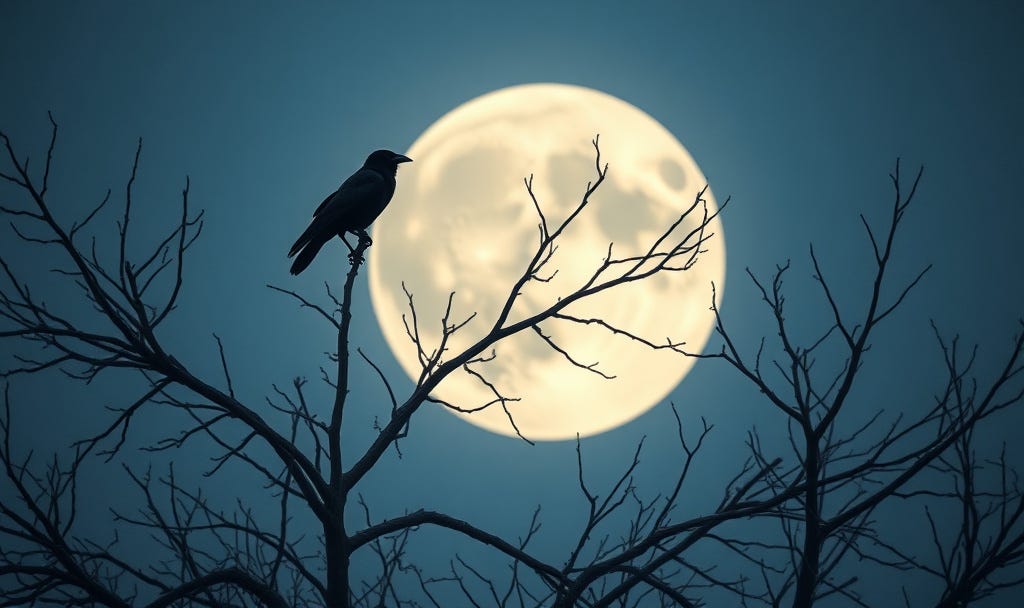
The winter night is deep. Cold winds cut through the bare branches.
A hundred birds huddle on the old oak, feathers puffed, eyes half-shut.
I perch on the highest limb, black feathers catching the pale moonlight.
I speak.
“You all sleep so warm, so tight.
Humans down there, they do not know warmth like this.
I watched their homes today.
Some shine with gold and light,
Others shiver in shadows, smoke curling from broken chimneys.
And they call themselves the smart ones.”
“A crow should not judge,” murmurs a bluejay.
“But you do,” it adds, almost shy.
I tilt my head.
“Yes, I do.
Because I see what they could be.
I watch families close their doors in anger.
I watch neighbors ignore cries for help.
I see the laughter of rich children,
the silent tears of the poor.
I see them fail themselves every day.”
A sparrow chirps softly.
“But why do they suffer so much?”
I ruffle my wings.
“Because their thinking is too heavy.
They build walls with money, with pride, with fear.
They look at each other, but they do not see.
I saw a man step over a child in need.
I saw a woman lock herself in her own loneliness
while the neighbor froze outside.
And still, they think intellect will save them.”
A pigeon coos from below.
“Are animals better?”
I hiss a laugh.
“Better? Not better, maybe simpler.
The mice shared their winter store with the newcomer.
The wolves moved as one, no one left behind.
Even ants, they carry each other, build together.
Humans? They have minds, but their hearts are tied in knots.”
The wind shakes the branches, snow dust falls.
A small robin shivers.
“Then is there hope?”
I flap my wings once, twice.
“Hope is in the stillness.
Hope is in noticing, in reaching.
Humans can still change, but it is hard.
Their intellect gives them power,
but their power does not make them see.
Tonight, I watch. I wait.
Tomorrow, maybe, they will see.”
The birds settle, murmurs die down.
Snow falls thicker.
The cold is no longer sharp, it is a blanket.
And I, black as the winter night, sit and remember
everything I have seen, everything they have forgotten.


There’s something quietly piercing about letting a crow do the speaking here, Tahir.
By choosing a witness without stakes or sentimentality, you strip away excuses and leave only contrast: intelligence versus care, complexity versus cohesion.
The observations don’t feel accusatory—they feel tired, as if the world has been seen too many times to be shocked by itself.
And that final note of hope, so restrained it almost disappears, is what makes it land.
Not really redemption, not awakening—just the possibility of noticing.
A cold, watchful, and thoughtfully humane piece.
Love it, Tahir! Amazing post! 💖👏🏼