
Against the Clocks
Questioning the nature of time.

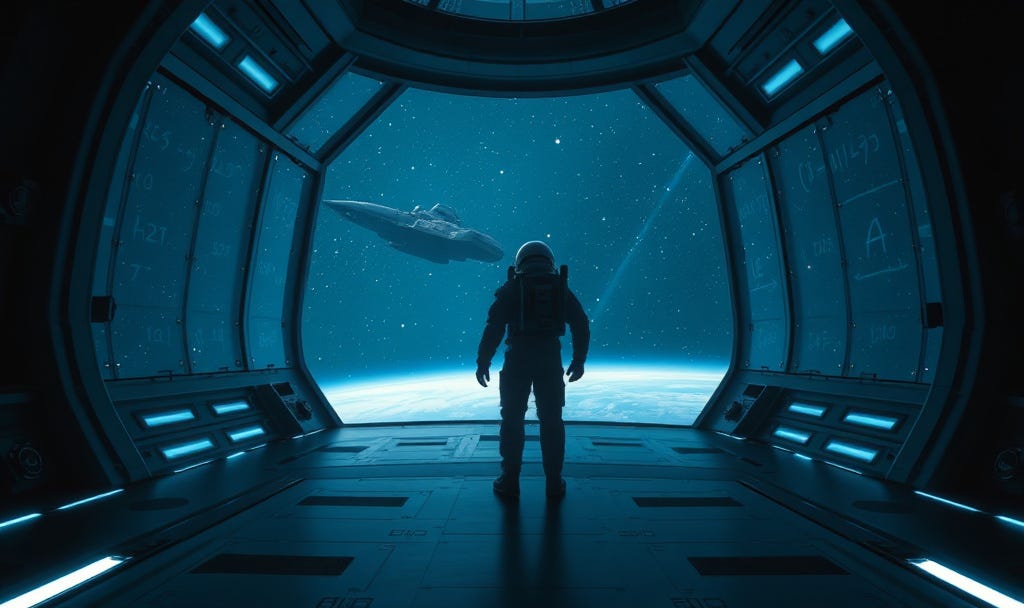
In The Space Between Seconds, Takkan returned from the journey with only three missing seconds.
Mamu called it relativity.
But the question refused to leave Takkan.
When a clock slows down,
what exactly slowed?
Takkan arrived at the station before sunrise.
The corridor lights glowed pale blue against the metal walls.
Half the sector still slept.
Somewhere deeper in the station, pipes groaned softly as the heating systems shifted.
Cold air brushed past him.
At the end of the hall, an observatory overlooked the stars.
Dr. Khajji stood alone inside, hands behind his back, watching equations drift across a wall display.
Takkan stopped in the doorway.
Takkan:
“You still trust those things?”
Khajji glanced sideways.
Khajji:
“The equations?”
Takkan:
“The clocks.”
A faint smile crossed the old physicist’s face.
Outside the glass, cargo ships drifted silently through the dark.
Their signal lights blinked at perfect intervals.
Measured.
Predictable.
Khajji:
“Clocks built this station.
They guide ships.
Keep people alive.”
Takkan stepped into the room.
Takkan:
“No.
People keep people alive.”
He looked toward the blinking lights.
“Clocks just count movement.”
Instead of taking offence, Khajji seemed intrigued.
Khajji:
“You came here to argue with physics?”
Takkan shook his head.
Takkan:
“I came because physics stopped making sense to me.”
Silence settled between them.
Only the low hum of machinery remained.
Takkan approached the wall display.
Atomic clocks.
Orbital synchronisation systems.
Navigation timers.
All of them repeating.
Ticking.
Oscillating.
Takkan:
“Everyone says my time slowed.
But what actually slowed?”
Khajji waited.
Takkan:
“My heart?
My thoughts?
Atomic vibrations?
Ship systems?”
Takkan rubbed at his eyes.
“What exactly proves time itself changed?”
Khajji:
“The measurements.”
Takkan gave a tired laugh.
Takkan:
“No.
The measurements prove measurements changed.”
Khajji studied him carefully.
Khajji:
“You think relativity is wrong?”
Takkan:
“I think people became too certain.”
Takkan moved toward the observatory glass.
“Every clock works through repetition.
Swinging.
Vibrating.
Pulsing signals.”
A navigation pulse blinked across the observatory wall. Somewhere beyond the station hull, a cargo vessel adjusted its trajectory against central station time.
He tapped the display lightly.
Takkan:
“If gravity alters the process, then the clock changes.”
He turned back.
“That proves the mechanism changed.
Not necessarily time.”
Khajji folded his arms.
Khajji:
“You separate clocks from time too easily.”
Takkan:
“Maybe everyone else combines them too easily.”
The physicist walked toward the window.
Khajji:
“Maybe that’s all clocks ever did.”
He paused.
“Reflect reality.”
Takkan:
“Or just reacts to it.”
Khajji looked at him for a long moment.
Khajji:
“And your alternative?”
Takkan hesitated, as though uncertain whether he believed himself.
Takkan:
“I don’t know if time exists the way people imagine it.”
Outside, one of the cargo ships disappeared behind the station ring.
Takkan watched the empty space it left behind.
Takkan:
“People talk about time like it’s a river flowing through the universe.
But nobody’s ever touched time.”
No answer came.
“Nobody isolated it.”
Takkan rubbed at the tremor in his wrist.
“Nobody held it in their hands.
Nobody showed it existing outside change itself.”
Khajji:
“You experience sequence.
Cause before effect.
That is time.”
Takkan:
“Or maybe that’s just order.”
Takkan lost his train of thought for a moment.
The silence stretched too long.
Takkan:
“Sorry.
That still happens sometimes.”
The room fell quiet again.
Takkan sat beside the observatory glass.
“If I place two stones on a table one after another, the stones aren’t carrying time inside them.”
He stared at his hands.
“I only remember the sequence.”
Khajji:
“Memory requires time.”
Takkan:
“Or change.”
Khajji smiled faintly.
Khajji:
“You sound more like a philosopher than a pilot.”
Takkan:
“Twelve months alone in deep transit does strange things to a person.”
Khajji:
“Fourteen.”
Khajji corrected gently.
Takkan’s smile faded a little too quickly.
Then laughed quietly.
Takkan:
“See?
That’s exactly my problem.”
Khajji watched him for a moment.
Khajji:
“You’ve been alone too long, Takkan.”
Takkan looked away.
Takkan:
“They keep asking whether I experienced temporal dissociation.
That doesn’t make me wrong.”
Khajji:
“No.
But isolation can make certainty feel louder than it is.”
Takkan:
“A day on Earth is one planetary rotation.
We turned that into twenty-four hours.”
He gestured vaguely upward.
“Another planet spins differently.
Different day.
Different year.”
He looked back at Khajji.
“So which one is the real day?”
Khajji:
“Both.”
He shrugged lightly.
“Time is relative to the frame.”
Takkan:
“Exactly.”
Takkan leaned forward now.
“Relative to systems.
Relative to motion.
Relative to matter.”
His voice softened.
Takkan:
“So maybe relativity belongs to systems.”
A pause.
“Not to time itself.”
The station lights dimmed briefly as power shifted between sectors.
For half a second, Khajji’s face vanished into shadow.
Takkan flinched anyway.
For a moment, only the stars remained.
Takkan:
“A man trapped in a room without clocks,
without sunlight,
without change…”
He swallowed.
“…he can’t know how much time passed.”
Khajji:
“His body still changes.”
Takkan:
“Yes.”
Takkan nodded immediately.
“Cells change.
Matter changes.
Thoughts change.”
His frustration surfaced again.
“But nobody ever sees time directly.”
Khajji exhaled slowly.
Khajji:
“Invisible things still shape the world.”
Takkan frowned.
Khajji:
“Gravity is invisible too.
But reality bends around it.”
Takkan said nothing.
Khajji:
“And causality remains consistent
everywhere we look.
If time isn’t real,
why does cause still lead to effect?”
Takkan stared through the observatory glass.
After a while, he answered quietly.
Takkan:
“Maybe because change itself has structure.”
The physicist watched him carefully now.
Not as an opponent.
As someone trying to hold himself together.
Finally Khajji spoke again.
Khajji:
“Time dilation isn’t imagination.
Atomic clocks prove it.”
Takkan closed his eyes briefly.
Takkan:
“They prove something changes consistently.”
Khajji:
“Predictably.”
Takkan:
“Yes.”
Khajji:
“Mathematically.”
Takkan nodded.
Takkan:
“But always through comparison.
One observer against another.
One process against another.”
A tired smile crossed his face.
Takkan:
“Maybe mathematics is just organised observation.”
Khajji raised an eyebrow.
Khajji:
“You don’t sound convinced.”
Takkan:
“I’m not.”
That answer came immediately.
Honestly.
Takkan looked back out into the dark.
Takkan:
“That’s the worst part.”
The silence between them deepened.
Outside, another ship crossed slowly between the stars.
Its signal lights blinked in steady intervals.
Measured.
Repeating.
Like every clock humanity had ever trusted.
Takkan spoke again, barely above a whisper.
Takkan:
“When I came back…”
The words caught inside him.
“Everyone talked about the missing time like it belonged to physics before it belonged to me.”
Khajji said nothing.
Outside, the lights kept blinking into the dark.


The blinking ship lights... I hate how everyone else gets neat little intervals, and Takkan is there trying to make three missing seconds belong to him before they get handed to physics.
Couldn’t help but fall for Takkan, deeply reflective and questioning, someone who doesn’t just accept answers but keeps searching when something about reality doesn’t feel right. We need more people like him. <3